
1
Step 1


Art Galleries // White Glove Moving
Published December 12, 2025
Written by EA Support Team
Read Time Approximately 15 minutes
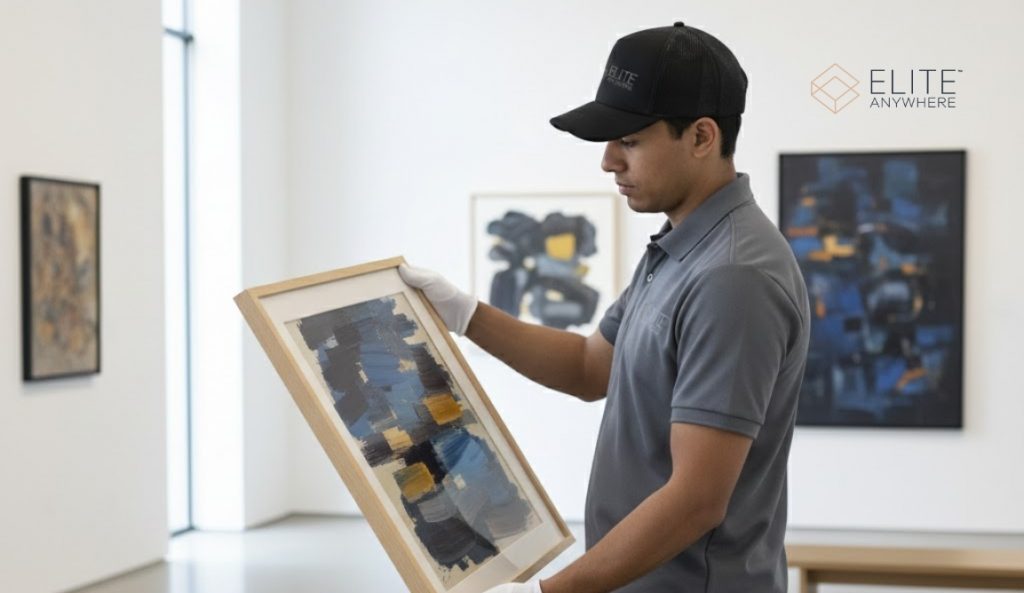
Moving artwork can be stressful for both the artist and the owners, especially during gallery exhibitions. Art collectors consider it an investment, often selling at unexpected, massive prices during displays and auctions.
The quality of an art should remain the way it should be from its previous location to the day it’s delivered and installed. Fine art demands precision, expertise, and meticulous planning at every stage from the moment it’s decided to be relocated to the final installation in a gallery space.
This comprehensive guide walks you through the entire process of how to move artwork safely and professionally. We’ll cover everything from pre-move planning and expert packing techniques to transportation logistics and gallery installation. By the end, you’ll understand exactly what it takes to move artwork for exhibitions with confidence and care.
Each artwork may require a unique approach based on its size, material, and fragility. Whether transporting priceless paintings, delicate sculptures, oversized installations, or mixed-media pieces, the stakes are high. A single mistake, improper packing, temperature fluctuations, or rough handling, can result in irreversible damage to irreplaceable works.
Beyond the financial loss, damaged artwork can derail exhibition timelines, disappoint collectors, and damage your gallery’s reputation. Before anything else, you need a complete understanding of what you’re moving. This means assessing each artwork, including:
Create a detailed inventory spreadsheet listing each piece with photos, dimensions, materials, estimated value, and any special handling notes. This becomes your reference document throughout the relocation process.
According to Forbes, moving costs have risen by 9% with a typical long distance move averaging $4600. Knowing what drives long distance moving expenses can help businesses plan wisely and budget effectively. Here are the main factors that affect pricing:
To increase visitors, museums today are pressured to share their collections with a mass audience, often collaborating on exhibitions. These artworks are transported around the world, involving complex and costly logistics due to the insurance, packing, handling, and installation processes. With the market value for these pieces continuing to grow, so as the number of fairs.
The risk involved in protecting different art pieces is also doubled as the constant move endangers their condition. This is why curators contact a logistics company that has a wide network of connections from one country to another. Museums often hire trustworthy installation teams to help plan large exhibitions. While these efforts are not mostly seen during the day of the exhibition, every team behind this event knows well the hard labor it demands.
But not all logistics teams are equipped to handle fine art. This is where the difference between standard movers and white glove logistics becomes critical.
Standard Movers:
White Glove Art Logistics:
For gallery exhibitions, white glove logistics isn’t a luxury but a necessity. The cost difference is minimal compared to the risk of damage you might incur during the move.
Respect for project timelines is important when coordinating with gallery schedules and exhibition openings. Exhibition preparation takes up to 9-12months. To accommodate last-minute changes and special requests, this scheduling minimizes risks associated with production delays. For logistics alone, here’s the recommended timeline to follow:
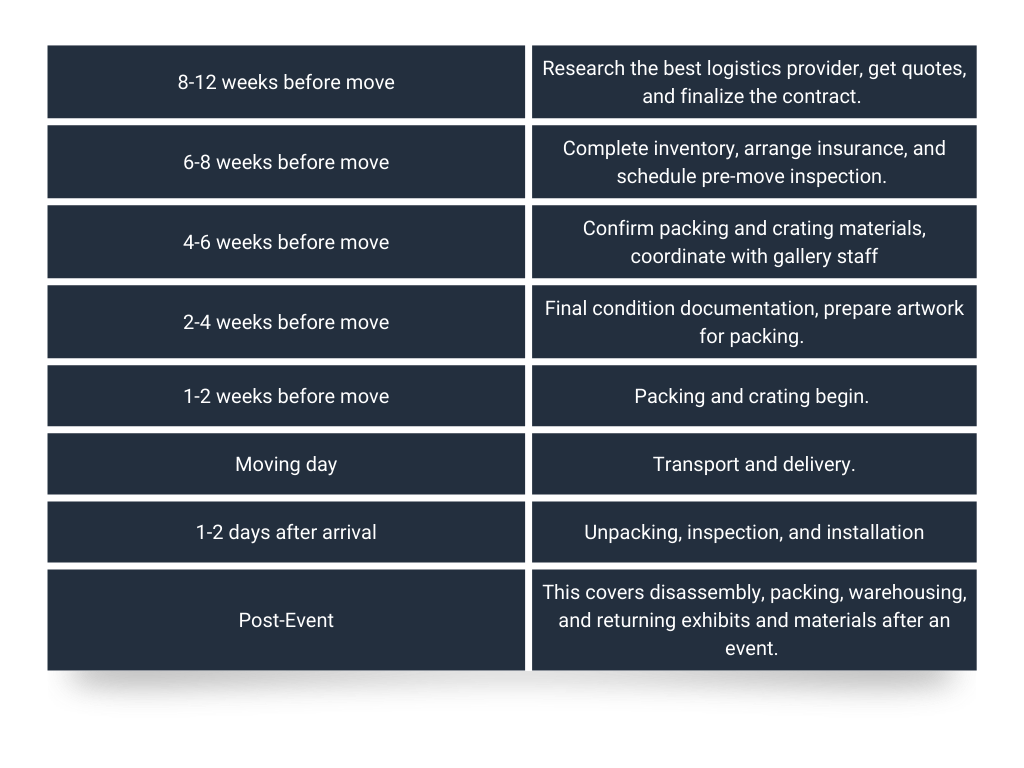
As observed, scheduling includes intentional buffer periods, preventing rushed decisions, and allows for contingencies.
Documentation is a standard for receiving and inspecting items in a warehouse. It protects both the company and the client’s interests. This also helps during a claim when products are lost or damaged at the hands of the mover.
Professional movers offer comprehensive coverage, including full replacement value, transit insurance, and liability protection for installation services. With a standard mover, liability covers only $0.60 per pound, which is inadequate for fine art, being light but extremely valuable. Specialized fine-art insurance policies offer broader protection, offering full-value coverage that reimburses the actual replacement cost if damage occurs.
Professional crating is an art form in itself. Different artwork types require tailored approaches.
For paintings and framed art:
Custom wooden crates with interior padding are used to ensure maximum protection. Acid-free tissue, archival materials, and foam corner protectors are added to safeguard delicate surfaces and edges. Once secured, the piece is sealed and stored in a climate-controlled environment to preserve its condition.
For sculptures and three-dimensional pieces:
3D artwork is packed in custom-built crates with internal bracing that keeps the piece securely in place. During transit, shock-absorbing materials are added to prevent any movement or vibration. Small ventilation holes are added to the crate to prevent moisture buildup, and the exterior is clearly marked with fragile indicators for safe handling.
For oversized or mixed-media installations:
Oversized or mixed-media pieces are among the most challenging to move, as they require modular crating systems designed for large, irregular, or layered components. These items demand specialized handling, including clear assembly and disassembly instructions. Before packing, it’s best practice to document the item’s original condition with detailed photos to guide reinstallation and ensure accuracy.
Professional packing is where expertise makes a huge difference. This phase requires trained hands and meticulous attention to detail.
Before a single item is wrapped, handlers conduct a thorough inspection through:
Quality materials are non-negotiable when packing artwork. Check out this list of materials and labelling standards that are part of the professional protocols used by expert handlers to protect artwork at every stage of transport:
Labelling best practices:
Professional crating protects artwork during the entire journey. Ordinary packaging materials can risk damage or deterioration, which is why acid-free materials and carefully designed protective padding are used to safeguard each piece. Custom-built wooden crates are used to provide strong structural support, often reinforced with interior bracing and shock-absorbing materials to minimize movements.
Outside protections, like corner guards and edge reinforcement, provide increased protection against impacts. Each crate is thoughtfully labeled, documented, and photographed, so the condition of the artwork can be monitored at every stage.
White glove team positions crates in a cargo truck, making sure that sudden shifts are prevented during travel through straps and bracing. Proper weight distribution and a climate-controlled environment are monitored. Once everything is secured, a final verification check is done. A routine as strict as when museums ship world-famous artworks, where one misstep can mean millions in losses.
Transporting famous artworks can be compared to the protection afforded to celebrities when they are in public. This involves an extremely complex and costly process. Consider the installation of Caravaggio’s Boy Bitten by a Lizard in a museum in Antwerp. For valuable pieces like this, the artwork arrived discreetly in an unmarked crate after traveling under armed guard from Sicily. A team of curators, experts, and art handlers meticulously unpacked and prepared the painting with precision.
The scenario highlights how museums intentionally keep the complex logistics and behind-the-scenes processes of transporting and installing valuable art hidden from the public, protecting artworks with maximum security.
How artwork is transported directly impacts its condition upon arrival. This phase requires specialized vehicles and constant monitoring. Every gallery, museum, and collector may have unique standards, so logistics providers must understand these expectations and be equipped to deliver the level of service each client requires.
Select the Transport Mode
Climate-controlled vehicles are maintained at a stable temperature (typically 65–75°F) with controlled humidity levels (typically 40–55%). A dedicated art transport vehicle (not shared with other cargo) is used, where GPS tracking and real-time monitoring are installed. Depending on the size, weight, fragility, and value of the pieces, a professional driver trained in fine-art handling and two to three individuals are needed. For extremely valuable artworks, logistic companies apply maximum security measures, which can include accompanying staff or even police escorts.
Direct routes are planned before the scheduled transport time, where rough roads and excessive vibration are avoided. Weather conditions are also considered while coordinating ahead the gallery receiving schedules.
Regular check-ins are done by the transport team, including temperature and humidity monitoring. Usually, they follow laid-out protocols like maintaining secure, locked vehicles at all times and avoiding unnecessary stops or delays. They are trained to practice constant vigilance and contingency plans for emergencies.
Arrival & Temporary Storage
Upon arrival at the destination, proper handling continues. The team inspects all crates for transit damage before unloading, followed by documenting condition with photographs. Galleries often request to store artworks in a climate-controlled facility if not immediately unpacked, maintaining security. Additional fees are incurred when staff request to unpack items for a coordinated time of unpacking and display.
Unpacking and installation of artwork typically takes one to two weeks to complete. During this phase, gallery staff collaborate closely with white glove handlers to determine placement, discuss wall preparation, lighting, and environmental controls. The team carefully reviews all installation requirements and specifications, establishing clear communication protocols to address any issues that may arise.
Professional installation ensures the artwork is displayed safely and beautifully. At times, the artist provides installation instructions /de-installation report. Proper mounting hardware and supports are installed. The LED lighting system is adjusted to highlight each piece without causing damage. Security systems are then activated. A final walkthrough with the gallery staff is conducted before signing the condition report.
A condition report is a document used for tracking an artwork’s condition during transport and installation, helping both fine art logistic providers and galleries prevent disputes and maintain the integrity of the piece. This details the basic information(title, artist, date of creation, dimensions, and medium), photo, present condition, damage location, environmental condition, data for previous repairs and restoration, and affixed signatures.
If you’re looking for a quick-reference checklist to ensure nothing is overlooked, check this out:
Additional Reminders:
This reminder serves as a final shield against delays and cancellations, as the cost is minimal compared to the potential loss
When it comes to moving artwork for gallery exhibitions, your logistics partner makes all the difference. Elite Anywhere specializes in fine-art transportation and has earned a reputation as the trusted choice for galleries, museums, collectors, and institutions across the United States.
With years of experience, our team is trained in museum-quality handling standards and fine-art logistics protocols, customizing crates for each artwork. For transportation, our vehicles maintain precise temperature and humidity control. We schedule shipments to align with venue access times and anticipate potential delays.
For insurance, we offer full-value coverage that protects your artwork throughout the entire move. Worry less about delays; aside from our tracking system, included in our white glove service, are the constant updates from our customer care providers. We’ve successfully transported thousands of valuable artworks for galleries, exhibitions, and private collectors.
We understand that every artwork isn’t just valuable, it’s irreplaceable. That’s why we treat every piece with the respect and expertise it deserves. From pre-move planning through final installation, Elite Anywhere handles every detail with precision and care.
The foundation of a successful art move rests on three pillars: proper planning, professional handling, and partnering with experts. When you invest time in pre-move preparation, work with trained art handlers, you dramatically reduce the risk of damage and ensure your artwork arrives exhibition-ready.
Exhibition artworks deserve nothing less than white glove care from professionals who understand the stakes.
Framed artwork should be wrapped in acid-free tissue and archival-quality padding, then placed in a custom wooden crate with interior bracing. The frame should be protected with foam corner guards, and the entire crate should be sealed and clearly labeled as fragile. Climate-controlled transport prevents frame warping or glass damage.
It’s best to start planning 8-12 weeks before your move. This timeline allows you to select a qualified logistics provider, arrange comprehensive insurance, complete detailed documentation, and coordinate with gallery staff. Rushing the planning phase increases the risk of mistakes and damage.
Standard movers provide basic transportation with no installation services included and limited liability coverage. White-glove movers specialize in fine art, using trained handlers, climate-controlled vehicles, custom crating, and full insurance to ensure every piece arrives safely.
Yes. Elite Anywhere specializes in fine-art logistics and serves galleries, museums, and collectors across the entire United States. We handle everything from single-artwork moves to complete exhibition relocations with the same commitment to excellence and care.

Learn more about our specialized fine-art logistics solutions and discover why galleries trust Elite Anywhere with their most valuable pieces.

A complete end-to-end logistics company. From receiving to last-mile delivery and everything in between, our staff delivers a true white glove experience with meticulous care and attention to detail. Need something pickup up, crated, and delivered - anywhere in the world? Let's get started!
1
Step 1
keyboard_arrow_leftPrevious
Nextkeyboard_arrow_right