Customs Clearance Completed — What It Means
Seeing "customs clearance completed" on your tracking is good news — your shipment cleared the border. Here's exactly what that status means, what happens next, how long delivery takes, and what to do if nothing moves.

 Shipping & Freight
"Customs clearance completed" means your shipment has been reviewed and released by the customs authority in the destination country. The paperwork checked out, any required duties or taxes were handled, and the goods are legally allowed to continue to their destination. In short: the border step is done, and your shipment is cleared to move to final delivery.
"Customs clearance completed" = your shipment passed customs review and was released. The next step is handoff to a carrier for final delivery, which typically takes anywhere from a day to about a week depending on the destination and service level.
What happens after customs clearance is completed
Once a shipment clears, the process is usually quick and predictable:
- Release — customs hands the shipment back to the carrier or freight forwarder.
- Line-haul / transfer — it moves to a local facility near the destination.
- Out for delivery — it's loaded for the final leg to your address.
- Delivered — the shipment arrives and delivery is confirmed.
From "cleared" onward, it's essentially a domestic delivery — the international and border hurdles are behind it.
How long does delivery take after customs clearance?
There's no single number, but for most shipments it's one to seven days after clearance, depending on the distance to the final destination and the service level. Express couriers often deliver within a day or two of clearing; ocean freight and larger consignments take longer to move from the port to the door, because the container still has to be unloaded, deconsolidated, and handed to a domestic carrier.
If a week passes with no movement after "cleared," contact your carrier or forwarder. A cleared shipment that isn't moving is usually waiting on a local handoff, an unpaid delivery-side charge, or a documentation follow-up — none of which resolve on their own.
Shipment cleared customs but still not moving? Get a fast, free quote on door-to-door international shipping — no obligation.
Get a free quote →The tracking statuses, and what each one actually means
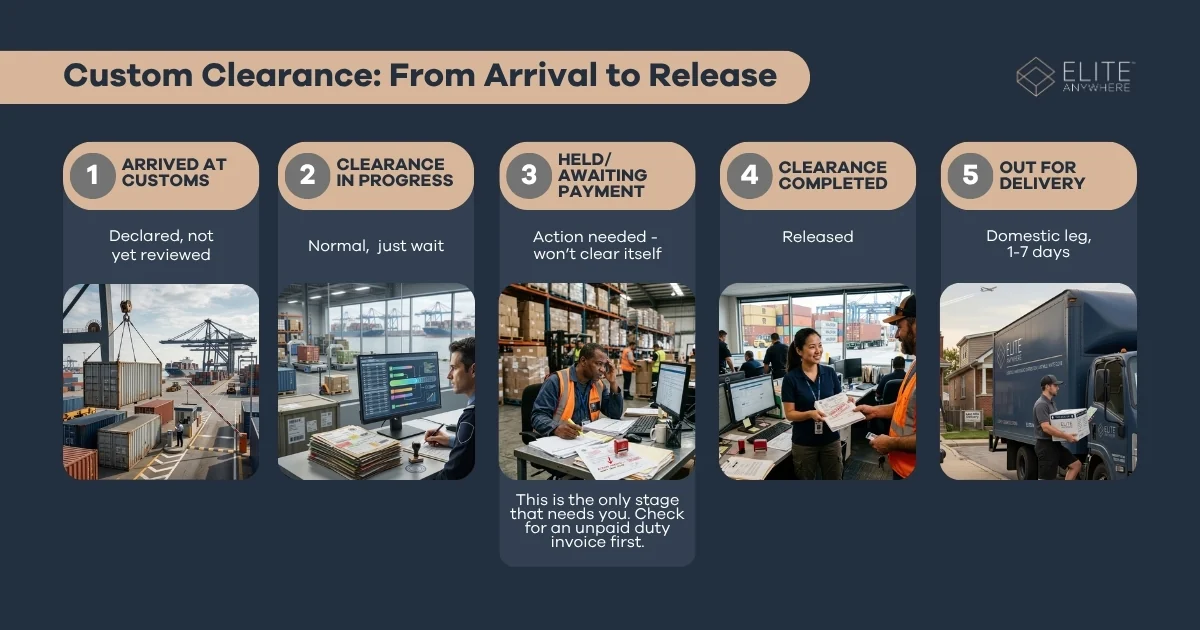
Customs statuses are worded inconsistently between carriers, which is why they cause so much confusion. Broadly, they map to the same sequence:
| Status you'll see | What's actually happening |
|---|---|
| Arrived at customs / presented to customs | The shipment reached the port of entry and has been declared. Nothing has been reviewed yet. |
| Customs clearance in progress / processing | An officer is reviewing the paperwork and classification. Most shipments sit here briefly and move on. |
| Held at customs / awaiting payment | Something is outstanding — duties, a document, or an inspection. This one needs action from you or your forwarder. |
| Customs clearance completed / cleared | Released. The shipment is legally free to continue to its destination. |
| Handed to carrier / in transit | Back with the delivery carrier, moving toward the final leg. |
The important distinction: "in progress" is normal and passive — "held" is not. If your status changes to held, don't wait it out.
Why a shipment sits in customs before it clears
Before you see "completed," a shipment can pause for a handful of routine reasons:
- Duties or taxes are unpaid. The most common cause, and the easiest to fix — the shipment is simply waiting for someone to pay.
- Documents are missing or don't match. A commercial invoice value that disagrees with the packing list, or a missing certificate of origin, will stop a shipment cold.
- The goods are misclassified. Every item is classified under an HS code, which determines the duty rate. A wrong or vague code invites a review.
- It was selected for inspection. Sometimes random, sometimes triggered by a risk assessment. Physical inspections add days.
- Restricted or regulated goods. Certain categories need permits or agency sign-off beyond customs itself.
The documents that decide how fast you clear
Most delays trace back to paperwork rather than the goods themselves. The core set is short:
- Commercial invoice — the transaction between buyer and seller, itemized with values.
- Bill of lading (or air waybill) — the transport contract and receipt.
- Packing list — what's physically in the shipment, and in what quantities.
- Customs declaration — the formal declaration of the imported goods.
- Certificate of origin — where the goods were made, which can change the duty rate under trade agreements.
These need to agree with each other. Customs officers aren't looking for perfection so much as consistency — a value, quantity, or description that differs between two documents is the single most reliable way to trigger a hold.
Who pays the duties — and why that matters to your tracking
Whether you or your sender pays affects how smoothly clearance goes. Under DDP (delivered duty paid), the sender covers duties and taxes in advance, so the shipment usually moves straight through. Under DDU/DAP (delivered duty unpaid), the receiver is billed — and the shipment waits at the border until someone pays.
If your parcel is sitting in customs and you haven't been asked for anything, check your spam folder and your carrier's portal. An unread duty invoice is one of the most common reasons a shipment stalls for a week with no explanation. Understanding where clearance sits in the wider journey — and what happens on the final delivery leg once the shipment is released — makes the wait a lot less mysterious.
Personal parcels vs. commercial shipments
The status reads the same either way, but what sits behind it is different — which is why a friend's parcel can clear overnight while yours sits for a week.
Personal parcels from marketplaces are usually cleared in bulk by the carrier, who acts as your broker automatically. Most move through with no involvement from you at all; when one does stop, it's nearly always a duty charge waiting to be paid or a vague item description on the seller's declaration — neither of which you control, and both of which the seller can fix.
Commercial shipments face more scrutiny: classification is checked more carefully, values are verified against the invoice, and the importer of record carries legal responsibility for the declaration being correct. More can go wrong, but you also have far more control over preventing it.
One thing that trips up first-time importers: clearing customs and paying duty are not the same event. A shipment can be released while a duty invoice is still outstanding, and the carrier will then hold it at the delivery end until that's settled — which looks identical to a customs delay on your tracking but isn't one.
What to do if your shipment is stuck
- Check for an outstanding duty or tax invoice first — it's the most likely cause and the fastest fix.
- Contact your carrier or forwarder with the tracking number and ask specifically what is outstanding. "It's in customs" is not an answer; ask which document or payment is missing.
- Get the documents corrected at source. If a value or description is wrong, the shipper has to reissue — you can't amend it from the destination.
- Escalate to a customs broker if it's been more than a week or the goods are regulated. A broker can talk to customs directly in a way an individual generally can't.
How to clear faster next time
Clearance speed is set long before the shipment reaches the border. Accurate commercial documents, correct HS classification, duties arranged in advance, and a consistent story across every document are what separate a shipment that clears in hours from one that sits for two weeks.

For businesses importing regularly, this is exactly what a customs broker or freight forwarder is for — they handle classification, prepare and file the paperwork, and resolve queries with customs officials directly, which removes most of the failure modes above. That's a core part of how we handle every international shipment.
If you import regularly, our guides to shipping from China to the USA and door-to-door shipping cover how clearance fits into the full journey — and door-to-door in particular removes the handoff where most post-clearance delays happen.
Quick answers.
What does it mean when customs clearance is completed?
What is the next step after clearance is finished?
How long does it take to deliver after customs clearance?
How long can a package stay in customs clearance?
Does "customs clearance completed" mean my package is out for delivery?
Why is my shipment still not moving after it cleared customs?
Do I have to pay duties before customs clearance completes?
Director of Operations · International Shipping & Freight at Elite Anywhere. Elite Anywhere runs receiving, storage, white-glove delivery, and installation for designers, brands, and private clients nationwide.
Explore Shipping & Freight →