
What Is Expedited Shipping?
Expedited shipping moves your order faster than standard — but "faster" means different things at every checkout. Here's what it actually covers, how long it takes, what it means on Amazon or Shein versus at FedEx, and when it's worth the premium.

 Shipping & Freight
What is expedited shipping? It's any delivery service that moves your order faster than the standard option — usually by prioritizing it in transit and using faster routes or carriers. It's the "get it there sooner" upgrade you see at checkout, and it typically means delivery in about one to three business days instead of the standard five to eight. The catch: "expedited" isn't a fixed speed. What it means depends entirely on the carrier, the seller, and the route.
Expedited shipping = faster-than-standard delivery, usually 1–3 business days. It costs more because your shipment is prioritized at every stage. It's worth it when the arrival date matters more than the price — a deadline, an event, or a time-sensitive item.
How long does expedited shipping take?
For most parcels, expedited lands in one to three business days, versus roughly five to eight for standard ground. The exact window depends on:
- Distance and zones — cross-country takes longer than regional, even when expedited.
- Carrier service level — "expedited," "priority," "express," and "2-day" are different named tiers with different guarantees.
- Cut-off times — an order placed after the daily cut-off ships the next business day, which quietly costs you a day of the speed you paid for.
- Business days, not calendar days — a Friday-afternoon expedited order often arrives Tuesday, not Sunday.
- Item type — freight and oversized goods follow entirely different timelines from small parcels.
The takeaway: don't assume a number. Read the specific service's estimated delivery date before you pay for it.
Is 2-day shipping considered expedited?
Yes. 2-day shipping is a form of expedited shipping — it's one named tier with a guaranteed window. "Expedited" is the umbrella term for anything faster than standard; "2-day," "next-day," and "priority" are specific promises underneath it.
The practical difference matters: if a firm arrival date is what you need, choose the tier with an explicit day guarantee rather than a vague "expedited" label. A guaranteed 2-day service commits to a date. Generic "expedited" often commits only to being quicker than the alternative.
Need it there faster than standard? Get a fast, free expedited shipping quote — no obligation.
Get a free quote →Expedited vs. standard vs. express
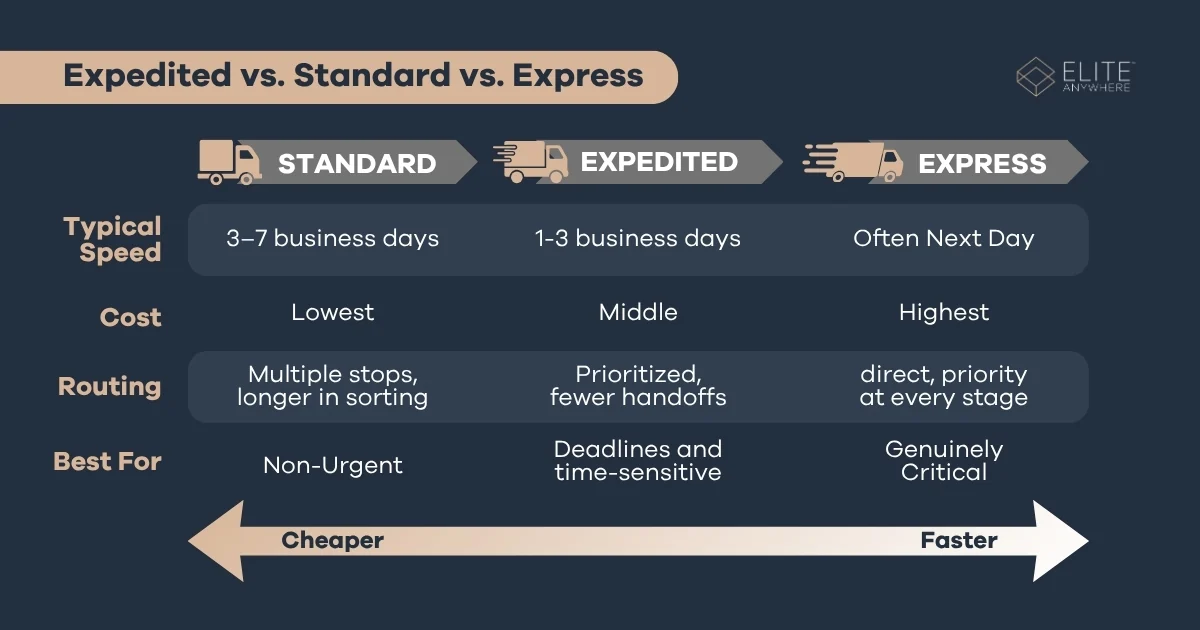
| Standard | Expedited | Express | |
|---|---|---|---|
| Typical speed | 3–7 business days | 1–3 business days | Often next day |
| Cost | Lowest | Middle | Highest |
| Routing | Multiple stops, longer in sorting facilities | Prioritised, fewer handoffs | Direct routes, priority at every stage |
| Best for | Non-urgent orders | Deadlines and time-sensitive goods | Genuinely critical shipments |
The three shade into each other, and carriers use the words loosely. Treat them as a rough ladder rather than fixed definitions, and check the actual committed date at each tier.
What "expedited" means at different checkouts
This is where most confusion comes from. "Expedited" is a label each seller and carrier defines for themselves — it isn't a regulated term with a fixed meaning.
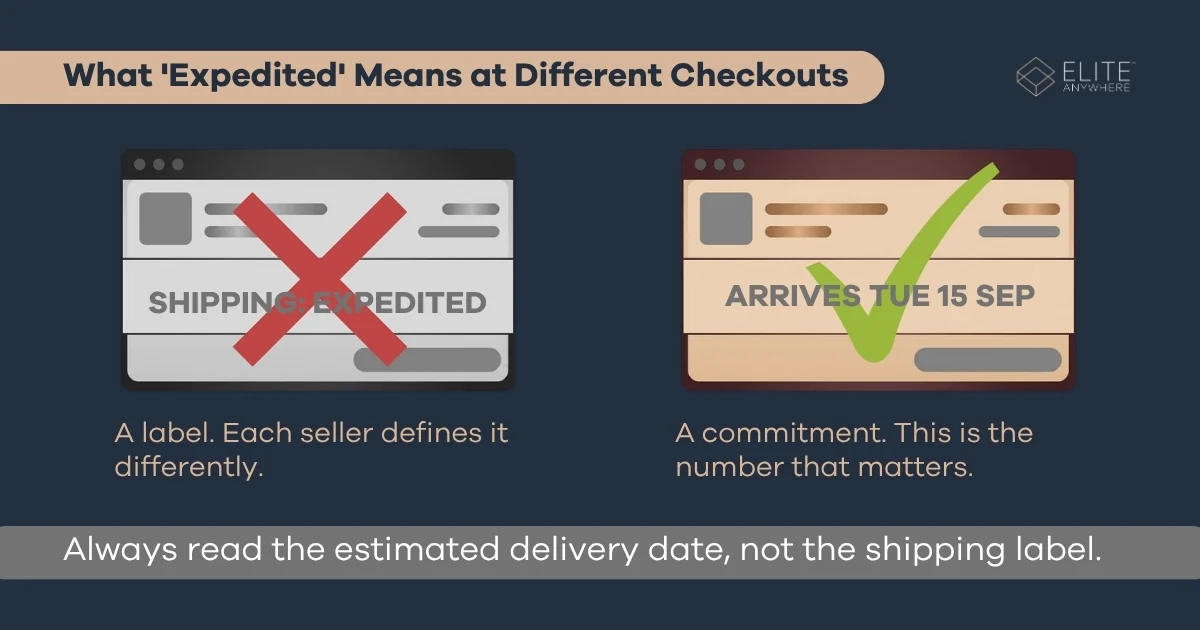
At a carrier, it maps to a specific named product with a published commitment — FedEx Express, UPS Next Day Air, and USPS Priority Mail Express are all distinct services with their own guarantees and cut-offs. At an online retailer, "expedited" at checkout is whatever that retailer has arranged with its carriers, which can differ by warehouse, by destination, and even by item.
That's why the same word can mean next-day from one seller and four days from another, and why a marketplace order shipping from overseas may show "expedited" and still take two weeks — the fast leg is only part of the journey.
Ignore the shipping label. The estimated delivery date is the only number that's actually a commitment.
If the date shown at checkout doesn't work, that's your signal to pick a higher tier or a different seller — not to assume the label will save you.
How expedited shipping actually works
Speed isn't magic; it's prioritization. Expedited shipments are pushed ahead of standard parcels at every stage — pickup, sorting, transit, and delivery. They're more likely to travel on dedicated trucks or by air, they take more direct routes with fewer handoffs, and some services run outside normal business hours specifically to hit delivery windows.
Because it bypasses the standard queue, an expedited parcel spends far less time sitting in sorting facilities, which is where most of a standard shipment's "transit time" is actually spent. That also means fewer handling points, which slightly reduces the risk of damage and loss along the way.
The service is only as good as the network behind it, though. A carrier without strong coverage in your destination region will struggle to hit an aggressive window no matter what you paid.
What expedited shipping costs
There's no universal figure. The price is set by:
- Weight and dimensions — heavier and bulkier costs more to move quickly, and dimensional weight applies here too.
- Distance — the further it travels, the higher the premium.
- How fast — overnight costs more than 2-day, which costs more than 3-day.
- Carrier and service — each has its own rate structure and guarantees.
- Extras — insurance, signature confirmation, and special handling all add on.
Rates change with fuel and season, so compare live quotes across services rather than assuming one carrier is always cheapest for speed.
When expedited shipping is worth the premium
Speed always costs more, so the question is whether the arrival date is worth it. It usually is when:
- You have a hard deadline — an event, a gift, a job site waiting on the item.
- The item is perishable or otherwise time-sensitive.
- A delay costs more than the upgrade — a stalled project, a missed install date, an idle crew.
- The item is high-value and you'd rather it spent less time in the network.
Pay for speed when being late costs more than being fast. Otherwise, standard shipping does the same job for less.
If you're offering expedited shipping to customers
For an online store, fast delivery is now an expectation rather than a perk. Offering an expedited option tends to reduce cart abandonment, since shoppers who need something by a date will otherwise buy elsewhere, and it lets you compete on service rather than price alone. The constraint is operational: you can only promise a window your fulfillment operation can actually hit, which means order cut-offs, stock accuracy, and same-day dispatch have to be reliable first. Our guide to pick, pack, and ship covers the process that makes fast dispatch possible, and 3PL warehousing covers outsourcing it.
For larger, high-value, or fragile items, speed isn't the only lever — how the item is handled on the final leg matters just as much. That's where our last-mile delivery solution comes in, and if you need the whole route handled end to end, see door-to-door shipping.

Quick answers.
What does expedited shipping mean?
How long should expedited shipping take?
How long do expedited orders take?
Is 2 day shipping considered expedited?
Is it worth getting expedited shipping?
Why does expedited shipping still take a week sometimes?
What's the difference between expedited and express shipping?
Director of Operations · Freight & Last-Mile Logistics at Elite Anywhere. Elite Anywhere runs receiving, storage, white-glove delivery, and installation for designers, brands, and private clients nationwide.
Explore Shipping & Freight →